-
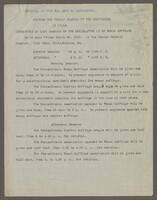 Pennsylvania Woman Suffrage Association public hearing program and procedure, 1912
 This itinerary provides scheduling and procedural information relating to a hearing on women's suffrage by the Commission on Bills at the Pennsylvania State Legislature.
-
 Reports of the Corresponding Secretary of the Pennsylvania Woman Suffrage Association, 26 November 1912
 This report summarizes the National Convention of the Woman Suffrage Association in Philadelphia, detailing the organizational status and sundry strategies of the women's suffrage movement.
-
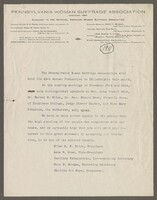 Pennsylvania Woman Suffrage Association 43rd Annual Convention notice, November 1911
 This notice gives information on the forty-third annual convention of the Pennsylvania Woman Suffrage Association, including dates and a list of guest speakers.
-
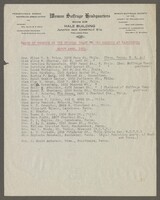 Names of Persons on the Special Train to the Hearing at Harrisburg, 14 March 1911
 A list of members of the Pennsylvania Woman Suffrage Association who attended a hearing about women's suffrage at the Pennsylvania State Legislature in Harrisburg.
-
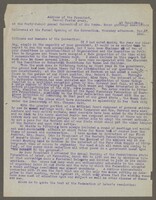 Address of the President, Rachel Foster Avery, at the Forty-Second Annual Convention of the Pennsylvania Woman Suffrage Association at Harrisburg, 17 November 1910
 This address was given by Rachel Foster Avery, a prominent suffragist and president of the Pennsylvania Woman Suffrage Association. The speech reports the status of the Association, changes in leadership and membership, relationships with other organizations, and strategies to promote women's suffrage.
-
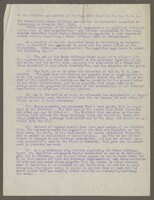 Committee report to the Executive Board of the Pennsylvania Woman Suffrage Association, 18 November 1910
 This committee was formed at the Pennsylvania Woman Suffrage Association Convention of 1910 to aid in the creation of the Woman Suffrage Party in Pennsylvania. The Party was created to organize women's suffrage clubs and facilitate the promotion of women's suffrage on the legislative level.
-
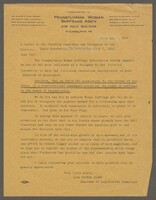 Pennsylvania Woman Suffrage Association letter to the Platform Committee and Delegates of the Keystone State Convention, 10 June 1912
 This letter from the Lida Stokes Adams, chairman of the legislative committee of the Pennsylvania Woman Suffrage Association, appeals to the platform committee and delegates of the Keystone State Convention to include a resolution on women's suffrage to the Convention's platform of principles. The letter specifies that the Association "[does] not ask...to endorse Woman Suffrage per se... [but] to recognize the popular demand for a referendum upon [the] question."
-
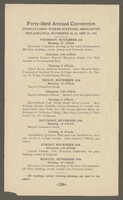 Forty-third Annual Convention Pennsylvania Woman Suffrage Association ephemera, November 23-25 1911
 This itinerary details the meetings for the Forty-third Annual Convention for the Pennsylvania Woman Suffrage Association in Philadelphia. Events included executive committee meetings, sessions at the mayor's reception room, and guest talks, including one given by Emmeline Pankhurst, a prominent British suffragists.
-
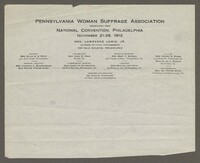 Pennsylvania Woman Suffrage Association National Convention ephemera, November 21-26 1912
 Letterhead for the Pennsylvania Woman Suffrage Association National Convention in Philadelphia. This item records Association officers, including Dora Kelly Lewis (Mrs. Lawrence Lewis Jr.), chairman, and Caroline Katzenstein, corresponding secretary.
-
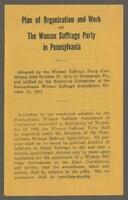 Plan of Organization and Work of the Woman Suffrage Party in Pennsylvania ephemera, 1913
 This pamphlet outlines the structure and promotion activities of the Woman Suffrage Party in Pennsylvania. The Party was formed in Harrisburg at the 1910 Pennsylvania Woman Suffrage Association Convention and operated under the direction of the Association.
-
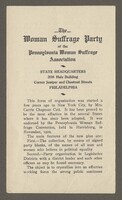 The Woman Suffrage Party of the Pennsylvania Woman Suffrage Association ephemera, 27 October 1911
 This leaflet, distributed by the Pennsylvania Women's Suffrage Association, provides information on the organization and its strategies for promoting women's suffrage.
-
 Opinions of Candidates for the Pennsylvania Legislature In Re An Amendment to the State Constitution Granting Political Rights to Women, May 1912
 This booklet, put out by the Pennsylvania Women's Suffrage Association, summarizes the opinions of candidates of the state legislature regarding women's suffrage. The survey begins with a brief review of the proposed women's suffrage bill, planks in party platforms related to suffrage, and the questions posited to the candidates themselves.
-
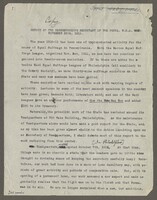 Report of the Corresponding Secretary of the Penna. W.S.A., 25 November 1911
 This annual report of the Pennsylvania Women's Suffrage Association details the various activities and events undertaken to promote women's suffrage. In particular, it discusses the founding of a headquarters in the Hale Building in Philadelphia, open-air campaigns, and the dissemination of pamphlets. This report was prepared by Caroline Katzenstein, secretary of the PWSA.
-
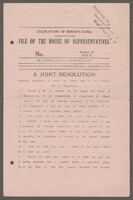 Legislature of Pennsylvania File of the House of Representatives [unnumbered], 1911
 A copy of a bill proposing changes to the state constitution that would allow women to vote. This proposal was only referred to the Committee on Judiciary General and never read before the Pennsylvania House of Representatives. A similar bill was voted on in the House in 1915, but it failed. In 1919 the state legislature ratified the Nineteenth Amendment.
-
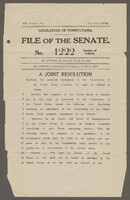 Legislature of Pennsylvania File of the Senate No. 1222 PN 805, 1919
 A copy of a bill brought before the Pennsylvania State Senate that proposed the ratification of the Nineteenth Amendment. The Bill was passed in June 27 1919, and Pennsylvania became the eighth state to ratify the Amendment.
-
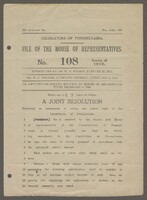 Legislature of Pennsylvania File of the House of Representatives No. 108, 1915
 A copy of a bill brought before the Pennsylvania House of Representatives proposing changes to the state constitution that would allow women to vote. The fifth stipulation of the proposal reads: "Wherever the words "he" "his" "him" and "himself" occur in any section of articles VIII of this Constitution the same shall be construed as if written respectively "he or she" "his or her" "him or her" and "himself or herself." The 1915 referendum ultimately failed, but in 1919 the state legislature ratified the Nineteenth Amendment.
-
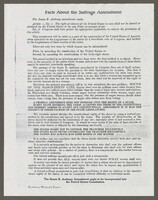 Facts about the Suffrage Amendment, undated
 A copy of a pamphlet circulated by the National Woman's Party that presents the argument for campaigning on behalf of a federal suffrage amendment instead of state-level amendments.
-
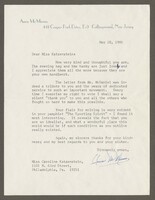 Anna McManus letter to Caroline Katzenstein, 18 May 1965
 Caroline Katzenstein was a prominent suffragist in the years leading up to the Nineteenth Amendment. In addition to her continued support for the Equal Rights Amendment, Katzenstein spent much of her time writing essays and articles under the pseudonym Carol Stone. Her 1939 essay, "The Sporting Spirit," documents her utopian ideals and urges her readers to think in terms of individual morality for the common good. She disseminated her essay to dozens of the most luminous academics and political figures of the time.
-
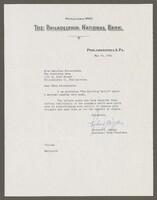 Richard C. Zebley letter to Caroline Katzenstein, 29 May 1964
 Caroline Katzenstein was a prominent suffragist in the years leading up to the Nineteenth Amendment. In addition to her continued support for the Equal Rights Amendment, Katzenstein spent much of her time writing essays and articles under the pseudonym Carol Stone. Her 1939 essay, "The Sporting Spirit," documents her utopian ideals and urges her readers to think in terms of individual morality for the common good. She disseminated her essay to dozens of the most luminous academics and political figures of the time.
-
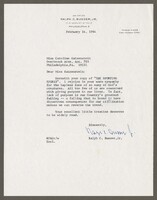 Ralph C. Busser Jr. letter to Caroline Katzenstein, 14 February 1964
 Caroline Katzenstein was a prominent suffragist in the years leading up to the Nineteenth Amendment. In addition to her continued support for the Equal Rights Amendment, Katzenstein spent much of her time writing essays and articles under the pseudonym Carol Stone. Her 1939 essay, "The Sporting Spirit," documents her utopian ideals and urges her readers to think in terms of individual morality for the common good. She disseminated her essay to dozens of the most luminous academics and political figures of the time.
-
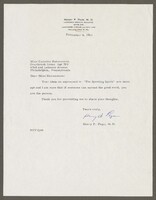 Henry F. Page letter to Caroline Katzenstein, 4 November 1963
 Caroline Katzenstein was a prominent suffragist in the years leading up to the Nineteenth Amendment. In addition to her continued support for the Equal Rights Amendment, Katzenstein spent much of her time writing essays and articles under the pseudonym Carol Stone. Her 1939 essay, "The Sporting Spirit," documents her utopian ideals and urges her readers to think in terms of individual morality for the common good. She disseminated her essay to dozens of the most luminous academics and political figures of the time.
-
 William H. Spencer letter to Caroline Katzenstein, 20 May 1957
 Caroline Katzenstein was a prominent suffragist in the years leading up to the Nineteenth Amendment. In addition to her continued support for the Equal Rights Amendment, Katzenstein spent much of her time writing essays and articles under the pseudonym Carol Stone. Her 1939 essay, "The Sporting Spirit," documents her utopian ideals and urges her readers to think in terms of individual morality for the common good. She disseminated her essay to dozens of the most luminous academics and political figures of the time.
-
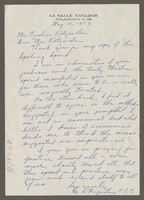 Brother D. Augustine letter to Caroline Katzenstein, 13 May 1956
 Caroline Katzenstein was a prominent suffragist during the years leading up to the Nineteenth Amendment. In addition to her continued support for the Equal Rights Amendment, she spent much of her time writing essays and articles under the pseudonym Carol Stone. Her 1939 essay, "The Sporting Spirit," documents her utopian ideals, urging her readers to think in terms of individual morality for the common good. She disseminated her pamphlet to dozens of the most luminous academics and political figures of the time. This letter is from Brother D. Augustine, the Chair of the Department of Sociology at La Salle College.
-
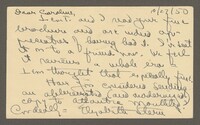 Letter to Caroline Katzenstein, 27 October 1950
 Caroline Katzenstein was a prominent suffragist in the years leading up to the Nineteenth Amendment. In addition to her continued support for the Equal Rights Amendment, Katzenstein spent much of her time writing essays and articles under the pseudonym Carol Stone. Her 1939 essay, "The Sporting Spirit," documents her utopian ideals and urges her readers to think in terms of individual morality for the common good. She disseminated her essay to dozens of the most luminous academics and political figures of the time.
-
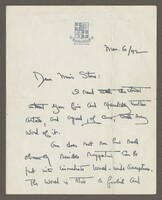 Letter to Carol Stone, 6 March 1942
 Caroline Katzenstein was a prominent suffragist in the years leading up to the Nineteenth Amendment. In addition to her continued support for the Equal Rights Amendment, Katzenstein spent much of her time writing essays and articles under the pseudonym Carol Stone. Her 1939 essay, "The Sporting Spirit," documents her utopian ideals and urges her readers to think in terms of individual morality for the common good. She disseminated her essay to dozens of the most luminous academics and political figures of the time.